A2WH Product Overview

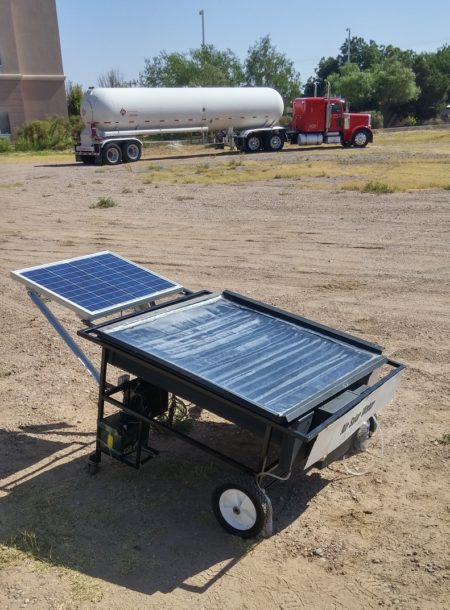
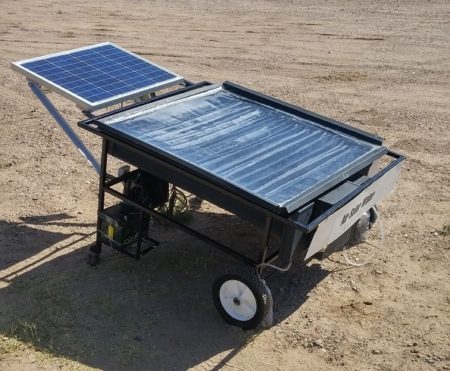
The A2WH system produces pure potable water from air using only solar energy.  It operates with a much lower operating cost than other AWG systems because it does not require large amounts of electricity.

The A2WH system absorbs moisture at night when humidity is relatively high and converts what it absorbed the prior night into liquid water the following day using solar thermal heat. Well over 90% of the energy used in the system is solar heat.

In this system all condensing occurs at near ambient and it does not require any refrigeration. High quality filters are used to filter the air before the absorption at night which keeps the interior of the system very clean.


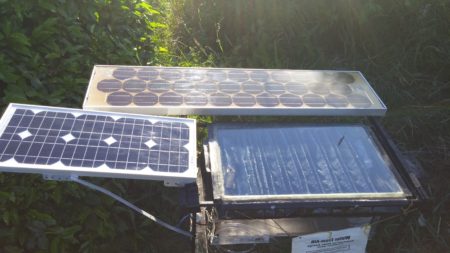
A small amount of energy is delivered by Photo Voltaic panels which operate a microcomputer control system, sensors, blowers, pumps, etc.

New A2WH Version:

  • Our new A2WH version is less expensive and can be more easily produced at a large scale.
    • Install as little as one square meter system to produce 32 ounces gallon per day
    • Very few moving parts and very low maintenance
    • Each 1.2 square meter unit will produce approximately 0.8 gallon per day during the summer
    • Thousands of Units can be combined to produce large volumes of water
    • The initial order for every country must be large enough to pay for patent filing in that country
    • We will license this unit for regional manufacturing
    A2WH main unit sout tilt no 3

    Producing water where it is needed:

    Imagine the ability to deliver safe drinking water in places where there is no power, no safe ground water, no available surface water and no viable rain capture. Imagine doing this where there isn't even any salt water or where the salt water is too contaminated to allow effective treatment.

    Every day solar heat cycles 1,356 cubic kilometers (358 trillion gallons) of water through the atmosphere.  A portion of this blows over  land where our AWG units can capture it and turn it back into fresh, pure liquid water usable for drinking,  cooking and crops. Our A2WH units can do this in the hottest deserts and in fact run best in hot sunny locations where water is needed the worst. We do not need rain, fog or any other form of precipitation.

    Our A2WH design has few moving parts which are easily serviced and can use low grade heat from simple solar collectors. This systems unique design makes it environmentally friendly  and suitable for cost effective scaling from small household models through industrial and institutional systems producing many million gallons per day.   

    Water

    Water is essential for human life. We drink it and use it for our crops. Water is already scarce and becoming ever more valuable. In fact the UN has predicted wars over access to fresh water. Shortages of water in California have already caused more than 100,000 acres of farmland to lie fallow as a result of the 2008 drought.

    Over 70% of earths surface is covered with water but very little of this water is useful for humans to drink or grow crops. 97% of all water is saline contained in the oceans which leaves only 3% as freshwater. 70% of the freshwater is locked up in ice leaving 22% as ground water and surface water. Ultimately less than 1% .of the world total is represented in lakes, rivers and wetlands.

    Adequate water is essential  for economic and political growth and stability. Our technology is specifically designed to deliver water in locations where unsafe or insufficient water is available. It was invented to allow continued development in areas where all other water sources have been exhausted or are fully allocated.   

    Ultimately we hope to see our water from air technology used to reverse desertification by providing sufficient water to establish green zones in the deserts. This will ultimately reduce food insecurity, reduce the risk of drought induced famine and reduce the poverty induced when people are forced to scavenge on a day to day basis just to obtain enough water to meet their basic needs.


    A2WH main unit sout tilt no 1

    How does A2WH work?

    The A2WH system uses a desiccant to absorb moisture from the air. The higher the humidity the more water our desiccant can absorb per pass which increases production.  

    We use solar heat to drive both the airflow for the absorption process and to provide heat during the regeneration process which extracts the moisture from the desiccant and allows us to capture the water in liquid form.

    A sophisticated micro controller based sensor system determines when to switch between absorption and regeneration modes. We use different types and amounts of desiccants depending on the local conditions to optimize the performance of the system. A small Photo Voltaic solar panel provides power for the micro controller, sensors, various valves, etc.      

    We have an optional enhancement that uses wind energy (wind over 4.5 MPH) to drive circulation at night when the relative humidity is higher. To make this work best we increase the weight of the desiccant used in the system. In some areas with good nightly wind this allows the unit to work in areas with daytime humidity as low as 10%  We have optional enhancements which allow electric fans and heaters to augment or replace the solar heat.

    The input air is filtered before it enters the absorption chamber where the desiccant absorbs water out of it. The air is re-filtered when heated for regeneration. A final stage of filtering is used as the air enters the condensation phase where the H2O is turned into liquid water.  As a result the output water is very pure. We still recommend treatment  using a NSF 54 grade filter prior to consumption because we do not have any control over the cleanliness of the storage tank.


    Our difference from common market units.

    Most Air to water systems use refrigeration to chill air to the dew point that means that as the dew point drops the more the unit must do more work to sufficiently chill the air. This causes them to use large amounts of electricity. It is fairly common for electric units to consume of 2.2Kwh per gallon produced which gives them a high variable operating costs which can exceed 40 cents per gallon.

    We designed A2WH units to operate entirely from solar energy. This is mostly solar heat with a small amount of solar electricity used to operate valves,  sensors and the electronic control system. This allows our system to operate much more efficiently which is especially important in areas where electricity is expensive such as islands where electricity is generated using imported fuels.  

    Most AWG systems are built around a refrigeration system which is very similar to that used in small electric air conditioners. The best units consume 600 to over 3,000 watt hours per gallon of water they produce. The industry average trends show consumption over 2,2000 watt hours per gallon which rise rapidly as humidity drops.    

    A2WH functions with no external electricity. This saves 3,000 watts per gallon. Our novel design and control system allows it to efficiently extract water in a wide range of conditions including conditions where electric AWG units become inefficient or do not work at all.

    NOTE:  We recently received a letter from a man who has a 40 acre ranch in a remote part of Arizona. He purchased an electric refrigeration unit. After investing $29,000 in solar panels and batteries his unit still doesn't work when the humidity drops below 48% RH and still does not deliver the rated production.

    Our units can reduce carbon emissions by over 5 pounds of carbon per gallon produced as compared to grid powered electric systems. (2.2 pounds carbon per KWh saved * 3000 watts per gallon = 6.4 pounds of carbon per gallon  of water). Even a small 6 gallon per day system this adds up to nearly 11,000 pounds reduced carbon emissions per year.

    Our system uses solar thermal heat to harvest water from air even when the air has low humidity. Unlike radiant condensation systems this system actually produces during the dry months even when there is no dew and it's production can go up in windy locations which can prevent radiant chilling systems from working at all. Our technology can work in conditions where the dew point is far below the chilling level delivered by radiant chilling panels.

    Our most important difference is the compatibility of the core design for scaling efficiently into millions of gallons per day at a reasonable cost. It's other major benefit is compatibility with remote areas where grid power is either unavailable or expensive. In some areas our units can be installed in mountains outside of towns and provide both water pressure and electricity for the town. Rather than exaggerate summer power shortages our system can actually help reduce these shortages.


    Partner Announcements

    The Rosenthall Group, Asia, Inc. Korea

    Typical Cost of water from the A2WH system :

    System description

    Production range

    Cost per gallon

    Cost per liter per day

    Small systems 1 to 50 gallons per day $0.30 - $0.15 per gallon
    Medium systems 50 to 500 gallons per day $0.20 - $0.10 per gallon
    medium large systems
    500 to 5,000 gallons per day $0.15 - $0.08 per gallon
    small industrial systems
    5,000 to 50,000 gallons per day $0.10 - $0.05 per gallon
    small municipal systems
    50,000 to 500,000 gallons per day $0.05 - $0.035 per gallon
    medium municipal systems
    500,000 to 5,000,000 gallons per day $0.04 - $0.015 per gallon
    large municipal systems 5,000,000 - 20,000,000 gallons per day $0.02 - $0.006 per gallon


    When a cost per gallon range is supplied the high end is qty 1 while the low end is qty 5,000. All costs are basic estimates and are influenced by region and fluctuating materials costs. All orders must be pre-paid and we lock prices in when the payment is received by pre-purchasing the supplies at that time.    


    To use this to calculate capital investment. Choose a system size such as 5,000 gallon per day system at $0.09 per gallon. Multiply daily production by 365 days per year to find the system will produce approximately of 1,825,000 gallons per year and 36,500,000 gallons during it's useful life. To obtain the capital cost you then multiply 36,500,000 * $0.09 per gallon = $3,285,000 purchase price. You should add local installation costs of about 20% and 7% annual service.


    Links


    Want to Help?

    We can use a wide variety of help.  Contact us and let us know how you wound like to be involved 206-601-2985 USA


    This file last modified